Now, if you are just getting to know me, I’m someone who loves exploring new things. I tend to dive in headfirst or spend a huge chunk of time researching before taking the plunge. Those impulsive dives often lead to one-off projects, but when it comes to something I see as a lifelong passion or skill, I like to map out all the possible paths it could take me; from as many learning possibilities I can find (courses, videos, books) to gathering the necessary tools and materials. By doing this, when I get started, I don’t have to slow down.
This method of deep diving before learning to swim gives me a solid understanding of techniques and best practices; it helps me troubleshoot and identify issues with a certain level of confidence, even if I’m not entirely sure of the solution. It’s also all about staying calm and enjoying the discoveries (successes and failures) that come with learning something new. Even failures have a lesson to be learned.
The Silk Resources That Started This Study
So, back to Silk! This all started with Rachel Smith’s course, Spinning Luxury Fibres: Silk, at the School of SweetGeorgia. Rachel’s course is fantastic. She covers a wide range of topics, from the history of silk, spinning techniques and different methods for making blends, using tools like hand carders, and wool combs, to using only her fingers. I’ve found myself rewatching her lessons numerous times to absorb all the different spinning draws, blending techniques and fibre management tips she has. She covers various silk types like Bombyx, Tussah, Muga, Pendulce, and Eri. SweetGeorgia Yarns has a Spinning Luxury Fibres kit with 10g of each of these silks which pairs perfectly with this course.
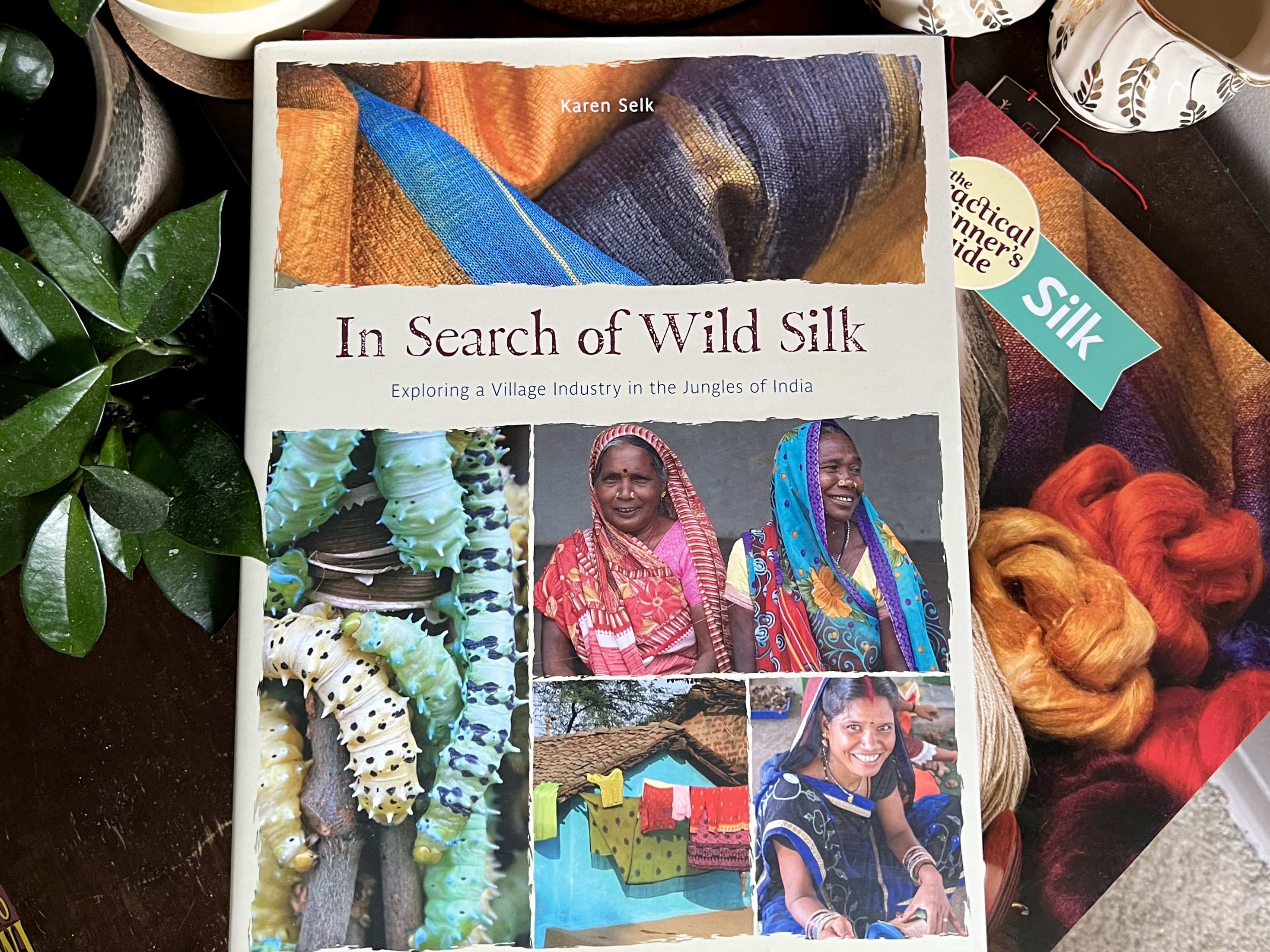
For those seeking a deeper understanding of silk, its cultivation, and its significance, I highly recommend Karen Selk’s book, In Search of Wild Silk. It’s a comprehensive resource that discusses the intricate process of wild silk production, shedding light on the lives of those who depend on silk as a source of sustenance and income. Although I’ve only just started to read this book, I can already say it’ll be a worthwhile investment for anyone interested in the subject.
Additionally, Long Thread Media offers a short yet informative video, About Silk with Karen Selk. At just 23 minutes, this video provides good information on silk, accompanied by helpful handouts in the form of PDFs (adapted from older Spin-Off articles). Priced at $10 US, it’s an inexpensive way to gain some knowledge about silk. And if you have a full-year, all-access membership to Long Thread Media, you can watch it for free. It’s a good starting point for anyone looking to dip their toes into the world of silk exploration.
Rachel Smith has an excellent resource list at the end of the course with various articles and books to dive into. Although I won’t list them all here, I will mention one of them is The Practical Spinner Book- Silks, by Sara Lamb. This book touches on the history of silk and how it is grown but goes deeper into the preparation, spinning, dyeing and uses for handspun silk (weaving, knitting, etc). This also led me to the Long Thread Media video, Spinning Silk: Sensuous, Successful Yarns from Luxurious Silk with Sara Lamb. This video covers a lot of what is in the book but if you are a visual learner and prefer videos, this may be for you. Both the book and video are great resources.

One thing Sara Lamb says a few times is, “Not every inch of yarn is precious, just move on”. This holds so much truth. While we can create yarns that are more curated to the projects we intend them for, hand spinning isn’t about making perfect yarn. We are not machines and handmade items come with beautiful flaws that make each thing very unique. I love seeing the marks of handmade items, whether it be slubs or occasional thin/thick spots, that bring true life to the yarn we make and the items we love.
I also dove into Spinning Wild & Unusual Silk with Judith MacKenzie and Spinning Exotic Fiber Blends with Sarah Anderson (which comes in handy for not just silk but all my luxury fibre spinning). With so many options, it is hard where to draw the line and just start spinning because ultimately my hands need to feel it, draft it, and spin it to fully understand it.
Back to Rachel. One thing I found very useful was the multiple ways she demonstrated how to hold and draft the fibre. While most of the spinners I mentioned only do long-draw style spinning, Rachel will also do a short-forward, a short-back and a continuous-back draw. For now, I only use a continuous-back draw style but later on, I will experiment with different draws as well.
Now when I refer to any of the names above, you will know who I am referring to and where I found this information.
General Information That Applies to All Silk
Silk comes in various grades, each with its unique qualities. Reeled silk, extracted from the outer layer of the cocoon, is prized for its sheen and strength. Spun silk, found closer to the cocoon’s interior, is slightly less lustrous and durable due to the tired state of the silkworm. Spun Silk is typically used in combed top. Silk Noil has a textured appearance with numerous noils and neps; hence the name. Noil silk, considered waste, undergoes a process similar to carder prep, ensuring no aspect of silk goes unused. Another type, gassed silk, involves burning off protruding ends from the yarn to achieve a smooth texture.
Grades categorize silk based on quality, with Grade A being reeled and gassed silk, Grade B commonly comprising of combed top, and Grade C attributed to noil silk, although exceptions exist within each grade.
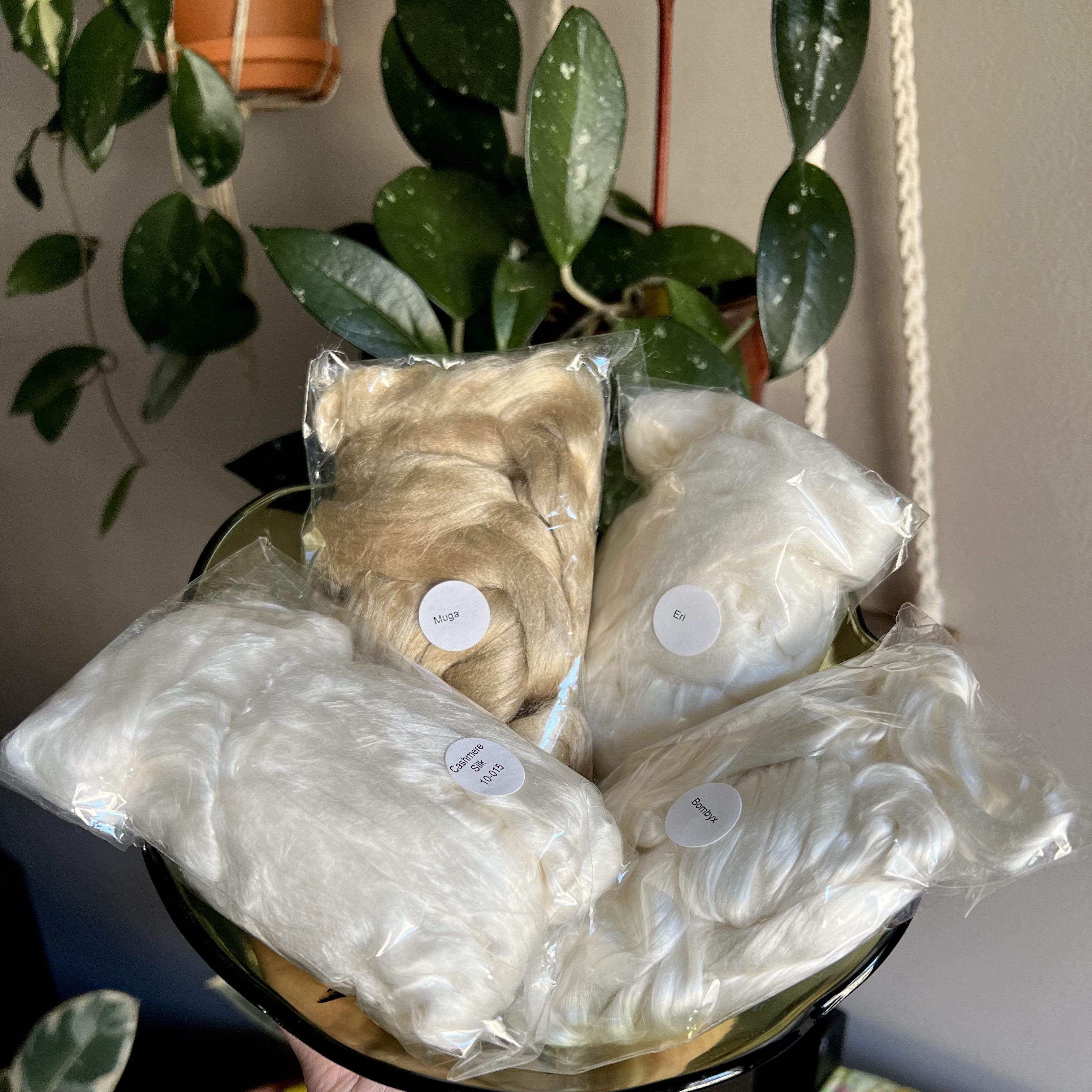
Did you know, it takes 19 strands of silk to match the thickness of a single strand of human hair. Sara mentions that Bombyx silk typically measures 10-13 microns, while Tussah silk ranges from 20-22 microns, both renowned for their softness. Muga silk shares similar properties with Tussah but boasts a lower micron count, making it slightly softer. Conversely, Eri silk stands out as the softest among wild silks, while also having the shortest staple length. The short length and the smooth nature of this silk make it one of the most difficult to spin. Another fun fact, 90% of global silk production consists of Bombyx or Tussah silk varieties; when silk type isn’t mentioned, it is usually one of the two.
As for the silk production process and information on the moths and their life cycle, there are many reputable resources and literature that cover these topics. There is no need for me to write about it but I’ll gladly provide links for further exploration at the end of this study.
Spinning Silk
My starting point is with Bombyx silk. It is interesting to see where I struggle in spinning silk and how each new silk following this spin is not just a new silk to learn but also a new measurement in my spinning growth. After Bombyx, I will move into Tussah, Peduncle, Muga and Eri silk. I also have plans to spin Mawatas, Silk Noil carded fibre, Sari silk, and possibly a few other fun silk options along the way. I also plan to spin silk with all of my other Luxury Fibre Spins, really expanding this study!
I’ve been told often that the results tend to remain relatively consistent across different silk types blended with wool; with only a subtle difference in the feel and look. Therefore, it wouldn’t make sense to approach each silk in the same way and expect drastic results. But what if I were to adjust my sampling process? Or tweak whorl ratios? Perhaps explore different drive system types, like transitioning from Scotch tension to Double Drive? Fibre prep or drafting styles? And what if I played around with spinning wheel dimensions? (Not sure I can manage to test that last one though). It will be fascinating to change some of these variables in my spinning process to see if they will produce different results. So let’s get started!
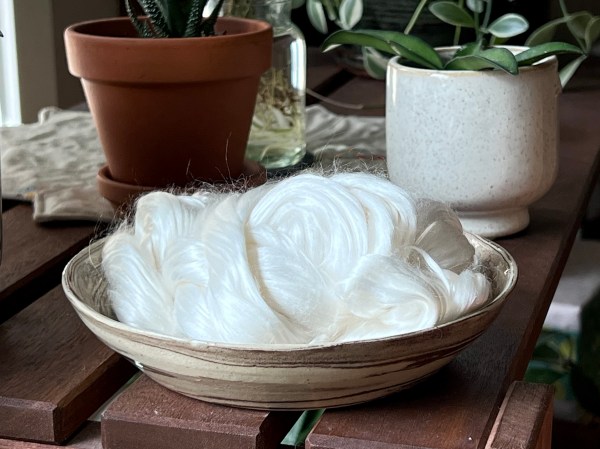
Bombyx/Mulberry Silk
Here are my humble first steps into spinning silk! I think most of my newbie-silk spinning mistakes will be made here. It may be worth revisiting at the end of this study….
Coming soon: Tussah, Peduncle, Muga, Eri silk and more!
 Exploring Slowcrafts