Also known as Bombyx Mori, Mulberry Silk, or Domesticated Silk
Let’s start with Rachel’s course, Spinning Luxury Fibres: Silk, from the School of SweetGeorgia. Following her guidance, I began spinning the Bombyx silk using a continuous back draw, which happens to be my preferred and default spinning method.
The continuous back draw technique falls somewhere between a woollen back draw and a supported long draw. In this method, the twist is allowed to travel up to the fibre supply hand, allowing air to be trapped within the yarn. However, with each twist-up, the drafting hand pinches the yarn, allowing the fibre supply hand to move/draft backward. After “continuously” doing this action several times, the distance between the orifice and the fibre supply is similar to the distance in a long draw, and the yarn is then fed onto the bobbin.
Despite silk’s slippery nature, keeping my hands further apart (which initially was scary) definitely proved to be beneficial. With many silk fibres being quite long, I found it challenging to draft smoothly when my hands were too close together, I could feel the gentle tug-o’-war beginning to happen. Sara recommends maintaining a drafting triangle of at least 2-3 inches long, which I was very mindful of as I spun. This added tip made drafting easier and helped me keep my hands further apart for a smooth and easy spinning experience. (Please read my Spinning Silk page for a rundown of people referred to in this post).
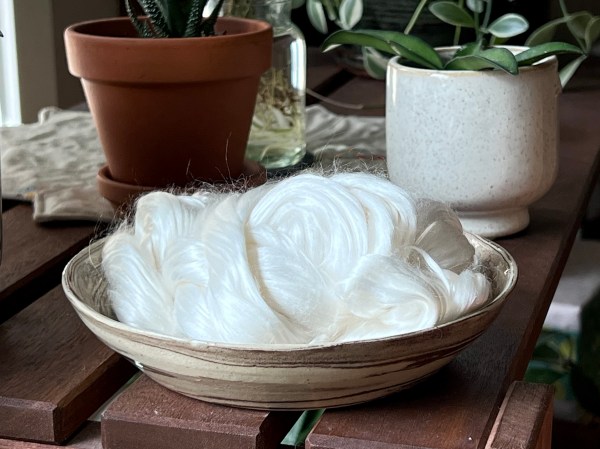
Another valuable tip from both Rachel and Sara was to hold less fibre. By working with smaller strips, I found that managing the fibre while spinning was much easier. Ask me how I know? Of course, I put this advice to the test, and yes, the silk fibre was much harder to manage and eventually became a small mess. Even though I had to pause occasionally to pick up another thinner strip, I found I could spin faster compared to holding onto longer, thicker strips of combed top.
Have you heard the expression, “Hold the fibre like a baby bird”? Well, that might even be a tad too much for spinning silk. It is not really about holding the fibre but about having my hand just firm enough to have something to pull back on as I draft back and nothing more, otherwise, I would end up with a balled-up mess. Remember, with the continuous back draw, the drafting hand pinches the fibre and remains stationed while the fibre supply hand drafts back. If you “hold” onto the fibre too tightly while drafting, the fibres drafted tend to be from the centre of the sliver, and the sides of the fibre will crumple back, creating a balled-up mess. Think of it like a drawstring bag. When open, the fabric is smooth, but when you pull on the string to close it, the fabric on both sides of the drawstring bunches around it. It is a similar concept. If that happens, it’s easy enough to stop and straighten it out. But wait too long, and you may need to stop to draft and realign the fibres. Trust me, I know from experience!
I decided to switch up my spinning style, taking the advice from both Rachel and Sara who suggest “over the fold” spinning. While this technique isn’t my go-to favourite, I found it to be particularly effective with silk. Sara also emphasizes the long draw style with double drafting when necessary throughout her videos. I will dive more into spinning draws/drafts later in the study but for now, will continue the continuous back draw method.
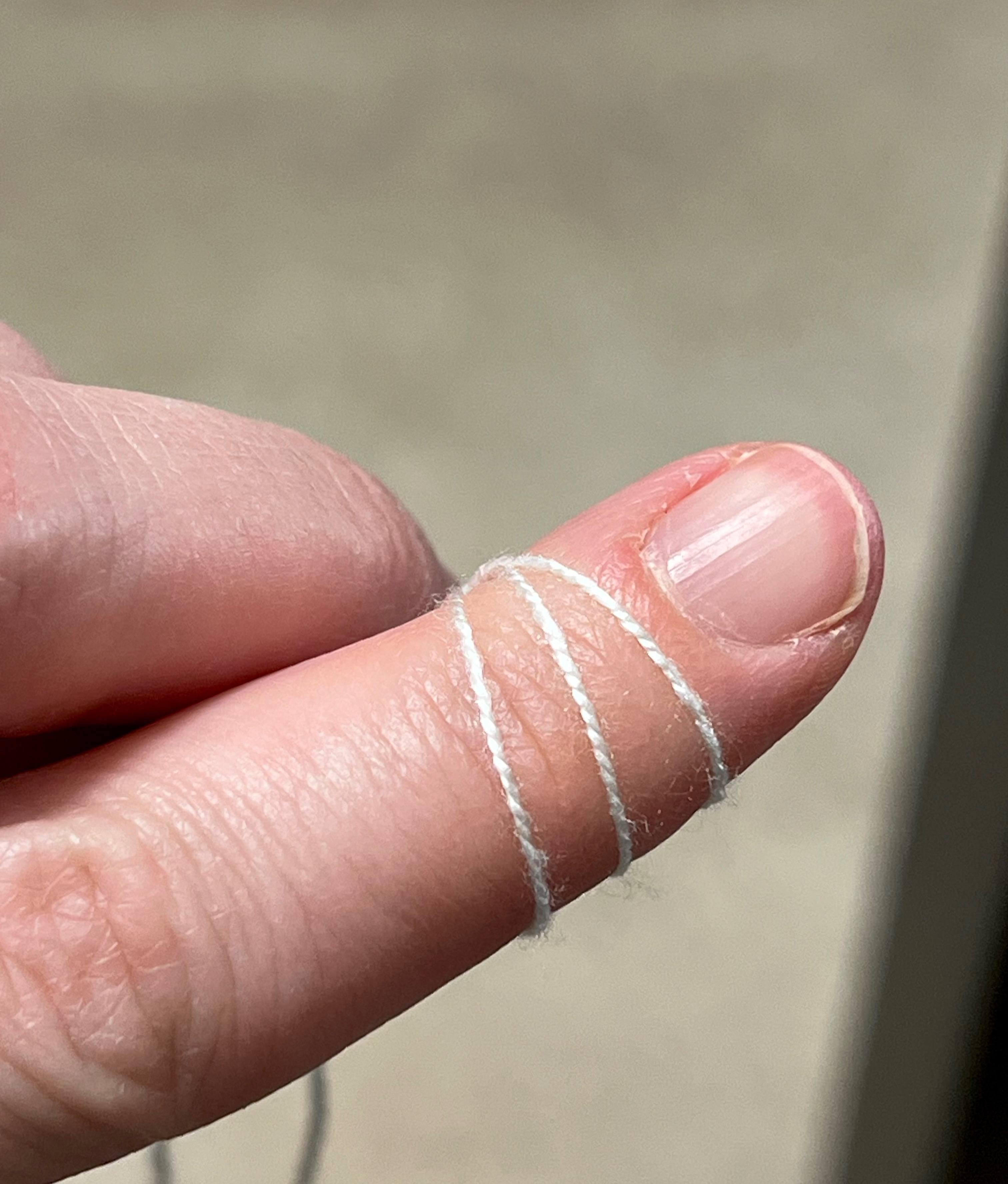
In my initial sample, I realized the silk yarn lacked the amount of twist needed. The singles had plied nicely but were very fragile-looking. This experience echoed my first encounter with spinning silk two years ago at the Manitoba Fibre Festival. During a course with Michelle Boyd on Three Ways to Bouclé, I was provided with silk for making a core yarn. I spun the silk slowly, proud that the yarn didn’t “get away from me,” but soon I encountered issues during plying as the yarn kept breaking and drifting apart.
This stresses the importance of adequate twist in silk spinning. Unlike wool, which has scales, silk relies heavily on twist to maintain cohesion. So, with my second sample, I added much more twist. Unlike some wools I’ve worked with, adding more twist to silk doesn’t result in a ropey texture. Although there may be a point where too much twist is detrimental, I found that even with significantly more twist in the singles than I had attempted before, the silk still feels soft, smooth, and strong.
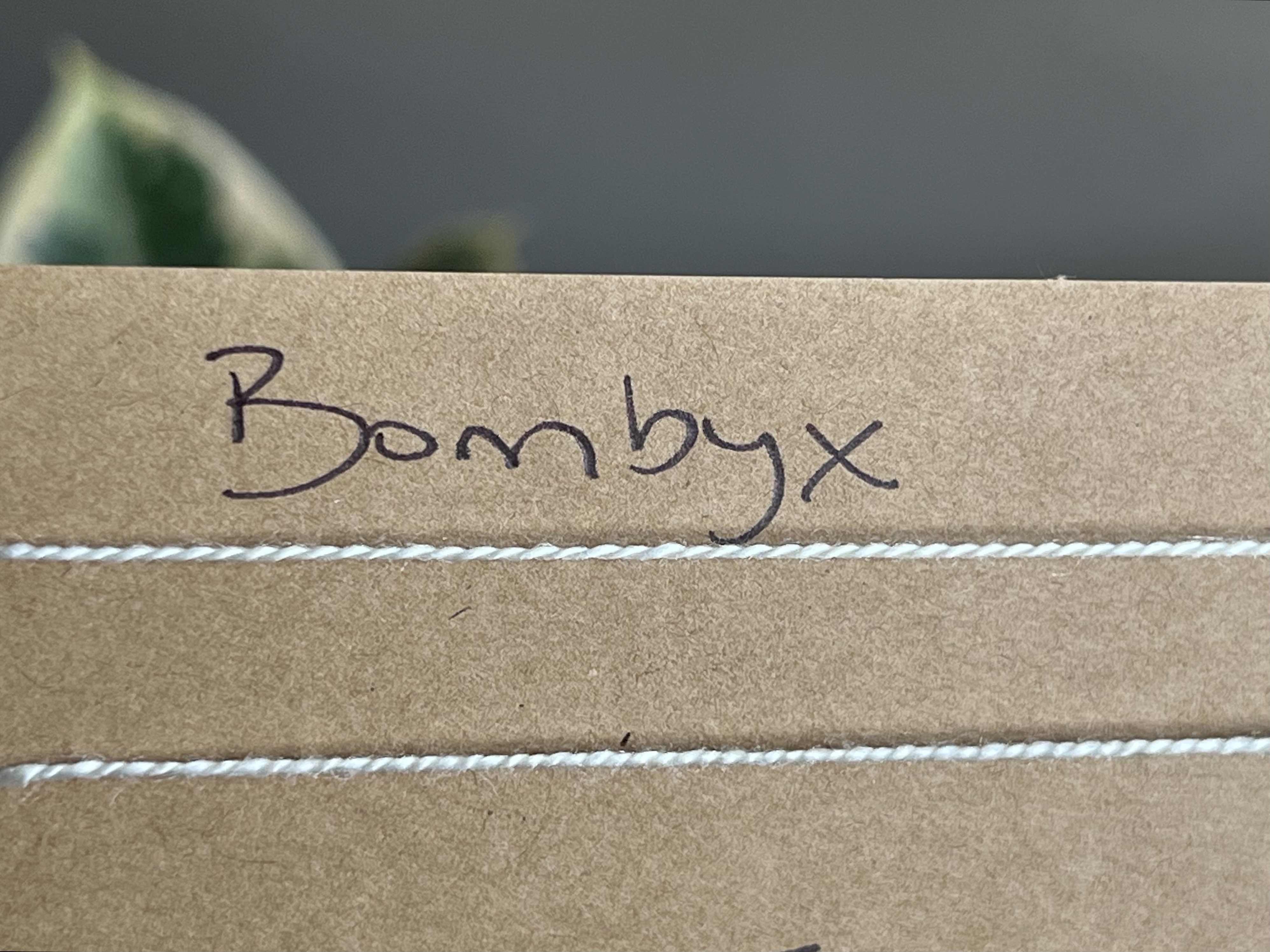
My sample card feels somewhat like a lie. The top plyback sample was taken from the wheel (before wet finishing), while the bottom was taken from the 5g sample. There is a noticeable difference in ply twist between them. This marks my second attempt at spinning silk, and it’s my first time truly honing in on the process. I won’t be too hard on myself for the initial results. I may re-spin this entire sample card later on, but I will continue with my studies for now.
Lapcloths. I usually use one while spinning, but if you don’t, I highly recommend it, especially for silk. I learned this the hard way when I didn’t realize my lapcloth had shifted while spinning, and I was wearing black leggings. The silk fibres rubbed against me, resulting in quite a mess… I ended up looking like I had been petting a cat for hours! Lesson learned: always ensure your lapcloth is in place, especially when working with silk.
Here’s a great tip: always keep scissors nearby when spinning silk. Despite hearing that silk is tough to break by hand, I still attempted to break off singles and it felt like it could cut through my skin. Ouch. Another piece of advice tested and proved to be true!
When plying, I usually keep my finger between the plies as they twist together. However, I found that this method was difficult to maintain a consistent-looking ply twist. Instead, I let the yarn spin between the groove on my first finger knuckle. This gave me a more consistent ply, especially with silk/wool blends in the fine to medium category. Interestingly, as I transitioned to long wools, I noticed my finger naturally came back into play, separating the plies while plying the yarn; the twist on those long wool blends looked great.
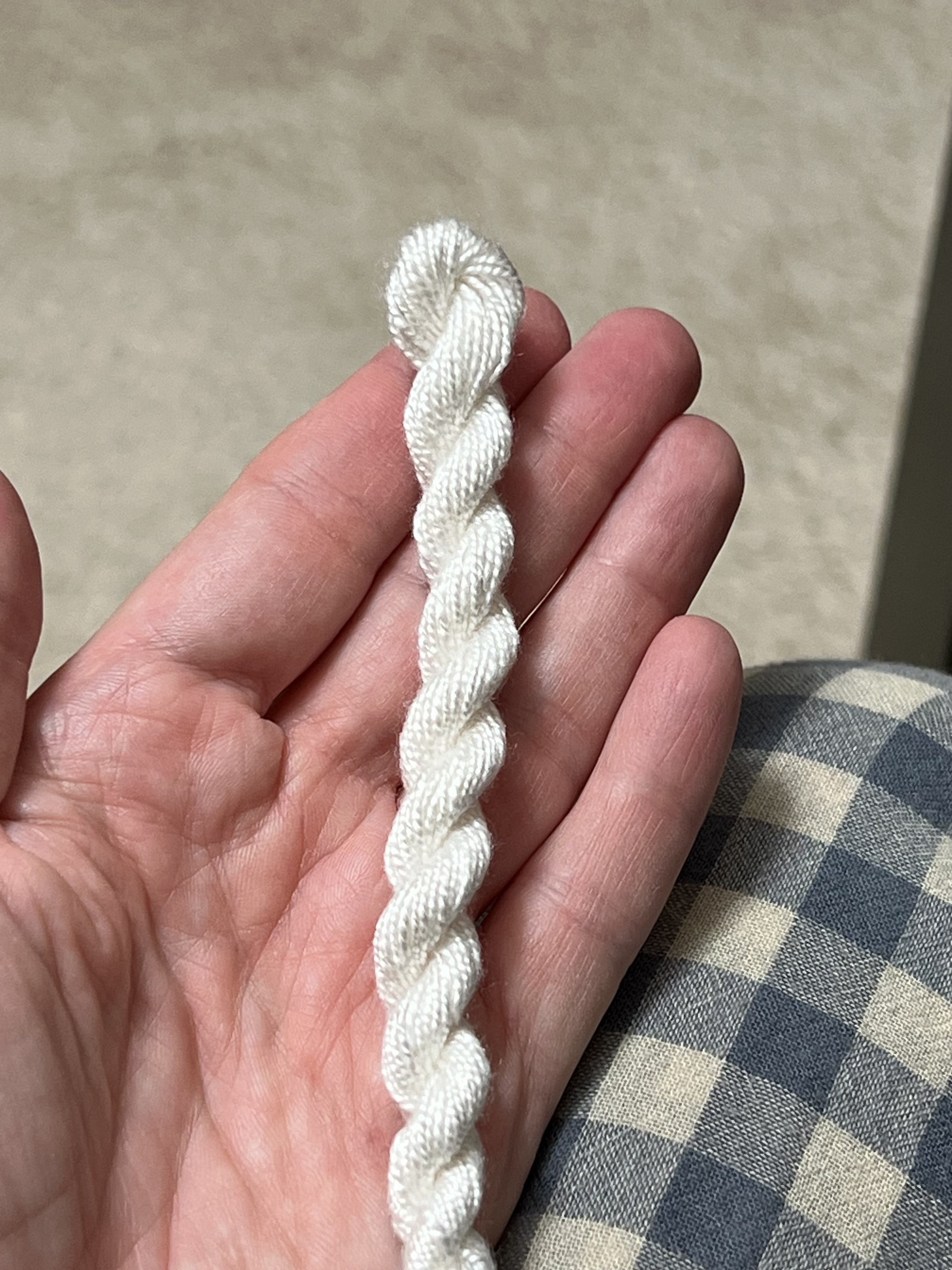
The sheen from the Bombyx silk is almost unreal. Despite numerous attempts, any picture I took seemed to wash out due to the silk’s remarkable lustre, which proved too much for the camera to handle. Its stunning appearance, coupled with its smooth, soft, and strong qualities, absolutely amazes me.
Is spinning silk difficult? Surprisingly, not as challenging as I had thought, as long as I maintained a slow and steady pace. There’s no need to treadle like the wind; simply holding the fibre for a few extra seconds before feeding it onto the bobbin will do the job. Actually, because of all the preparation and research prior to spinning, I didn’t find silk spinning to be particularly challenging. In fact, I didn’t expect to enjoy spinning silk as much as I do. Once I found the rhythm of drafting and treadling, spinning silk became pure joy. There were even moments when I zoned out, not watching my hands, yet still maintaining a smooth silk single.
Bombyx Silk & Wool Blends
Now, onto blending silk with different sheep breeds. While I’ve used my wool combs, blending board and carders to mix colours many times, blending different fibres is still somewhat new to me. As I mentioned on the Spinning Luxury Fibres page, I had a few trials and errors until I found a good blending method with the hand carders. All blends have a 75% Wool and 25% Silk ratio.
To be completely honest, when I read articles or view comparisons in photographs, I sometimes struggle to see the differences. While I can see the subtle variances in my own photographs, I also understand the challenge when viewing other people’s work. Actually, I considered not including photograph comparisons for that same reason.
I think the reason it is hard to see the differences is because the fibre arts are very tactile. Personally, I often find that I can visually perceive what I have previously felt. It’s similar to our sense of taste and smell; smell enhances the taste we perceive. If I’m familiar with how something feels, it can sometimes enable me to see its visual subtleties in photographs.
With this in mind, I’ve decided to include comparison pictures of each breed; with and without silk. My work here isn’t groundbreaking; experimenting with silk and wool blends has been done before, and will continue on after me. For those who’ve done a similar spin study, each picture will tell a richer story. For those who haven’t done a study like this, I urge you to give it a try. We can read about cause and effect endlessly, but nothing beats firsthand experience. I don’t expect everyone to pick up on the subtle differences in these pictures, so I’ve done my best to explain them in hopes that those who haven’t spun silk or wool/silk blends will have a sense of what it is like.
18-Count Merino-Extra Fine Wool

This was the first fibre blended with Bombyx silk. As I spun, the short staple of the Merino fibre prompted my hands to naturally gravitate closer together for a shorter draft distance. It seemed like the fibre was slipping away, particularly more so when compared to silk on its own. Increasing the draft distance led to noticeable bulges, requiring some double-drafting for a more consistent single. Eventually, I settled into a comfortable spinning rhythm, with a continuous back draw.
Attenuating the Merino-Silk fibre blend proved to be very helpful, despite using a diz to remove the fibre from the carder. The woollen preparation, passing of the fibre back and forth on hand cards, made a very woollen-style roving. Predrafting helped tame, smooth and remove bulk from this fibre preparation.
It’s been years since I last spun Merino, and rediscovering its charm, especially when blended with silk (while initially awkward), was delightful. I had forgotten how much twist Merino can withstand without feeling stiff, which makes it understandable why Merino and silk blends remain popular. The silk adds durability and keeps the wonderful Merino wool characteristics. It truly drafts and spins beautifully.
Polwarth- Fine Wool
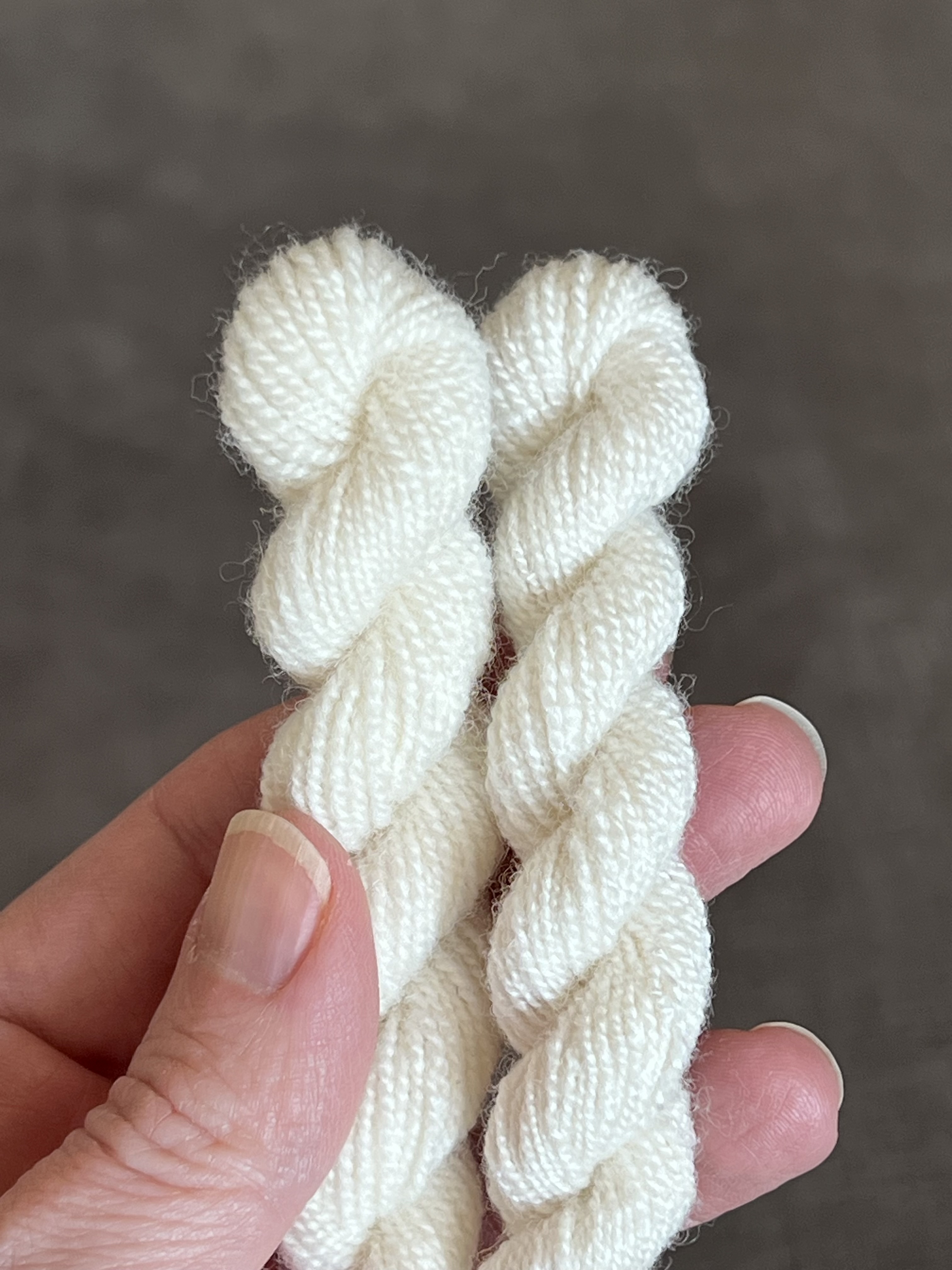
Because of the prep process (passed back and forth on wool combs), I ended up losing almost a whole gram of fibre; starting with only 5g, that’s a significant loss. It wasn’t the best approach for a short staple fibre blending with a longer stapled silk. I also encountered issues with drafting; large chunks of just silk followed by chunks of just Polwarth. While this had happened occasionally with my Merino blends as well, it was never to this extent. In hindsight, I realize I should have either cut the silk to match the Polwarth’s length or not used the combs at all. Perhaps with a longer wool, the wool combs might have worked better, but not in this case. Despite these challenges, I believe that if the Polwarth and Bombyx silk had blended more homogeneously, my spinning experience would have been similar to the Merino.
If you haven’t noticed yet, silk not only enhances lustre but also makes a smoother yarn with reduced loft. Additionally, the twist on the ply bumps becomes more pronounced because of the smoother single. If you enjoy the plumpness of Polwarth, a blend like this may deter you.
Corriedale- Medium Wool
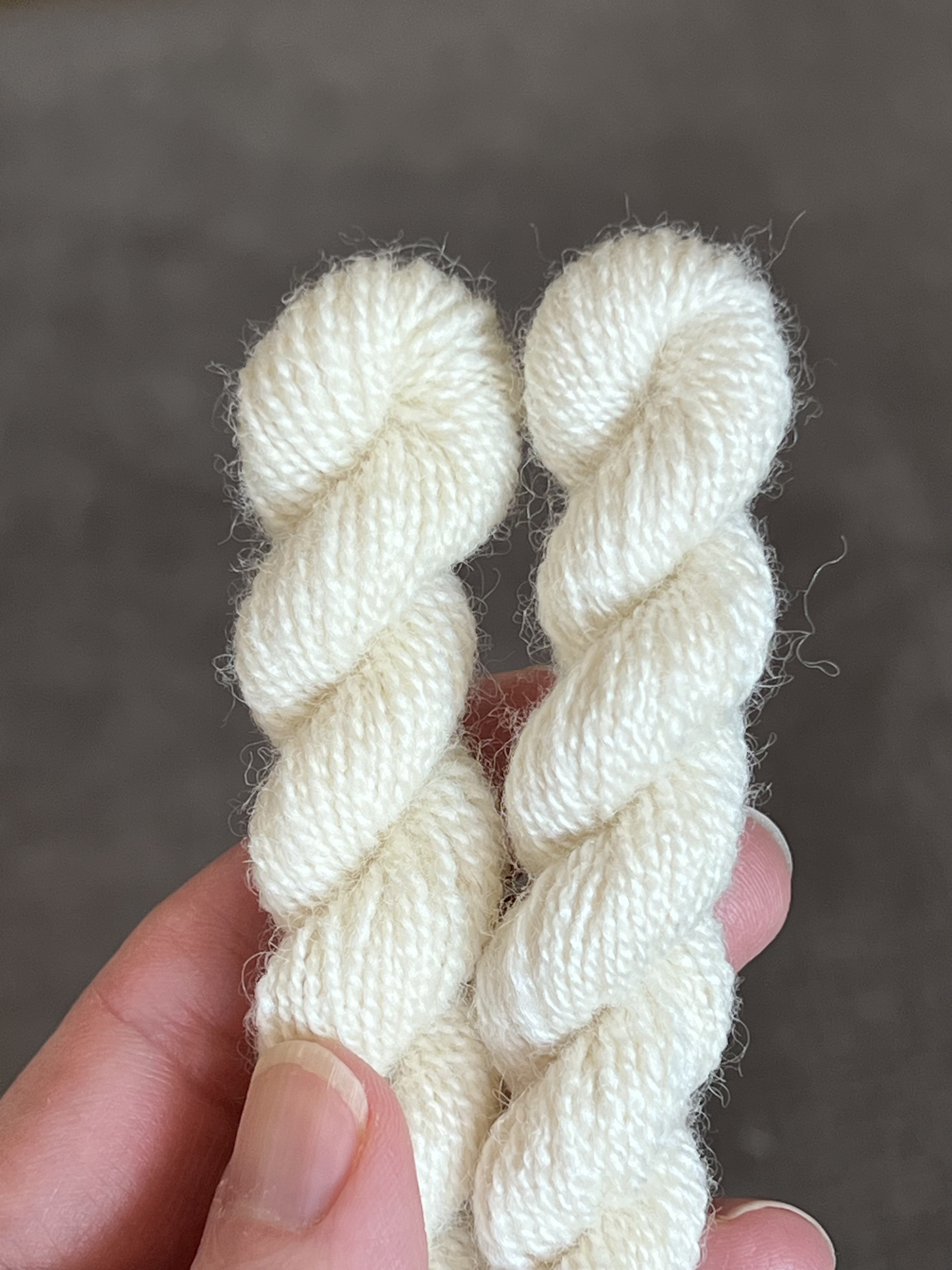
This prep was done on the blending board, and as I mentioned on the Spinning Luxury Fibres page. Somehow I ended up with a bunch of neps, which isn’t typical for this breed and is more commonly found in shorter breeds. It could have been due to how I loaded the board, perhaps. I will explore troubleshooting this one day, but not now.
I attempted to add extra twist like I did with the fine wools, but it just didn’t feel natural or correct. Since it’s a 75/25 blend, with the majority being wool, I remembered I should spin to the dominant fibre in the blend, which is wool.
Surprisingly, spinning this blend was incredibly pleasant. Similar to spinning the silk on its own, I could maintain a long drafting triangle and keep my hands comfortably distanced without much thought. My draw fell somewhere between a continuous back draw and a long draw. Due to the extended distance in spinning, I was able to spin this blend faster than the Merino and Polwarth singles. For plying, I added in extra twist compared to what I would typically use for 100% Corriedale. Considering the added softness of the silk, I believed it could handle it, and I was correct, this sample blend feels wonderful! And the silk sheen is perfect for this breed blend!
Romney- Long Wool
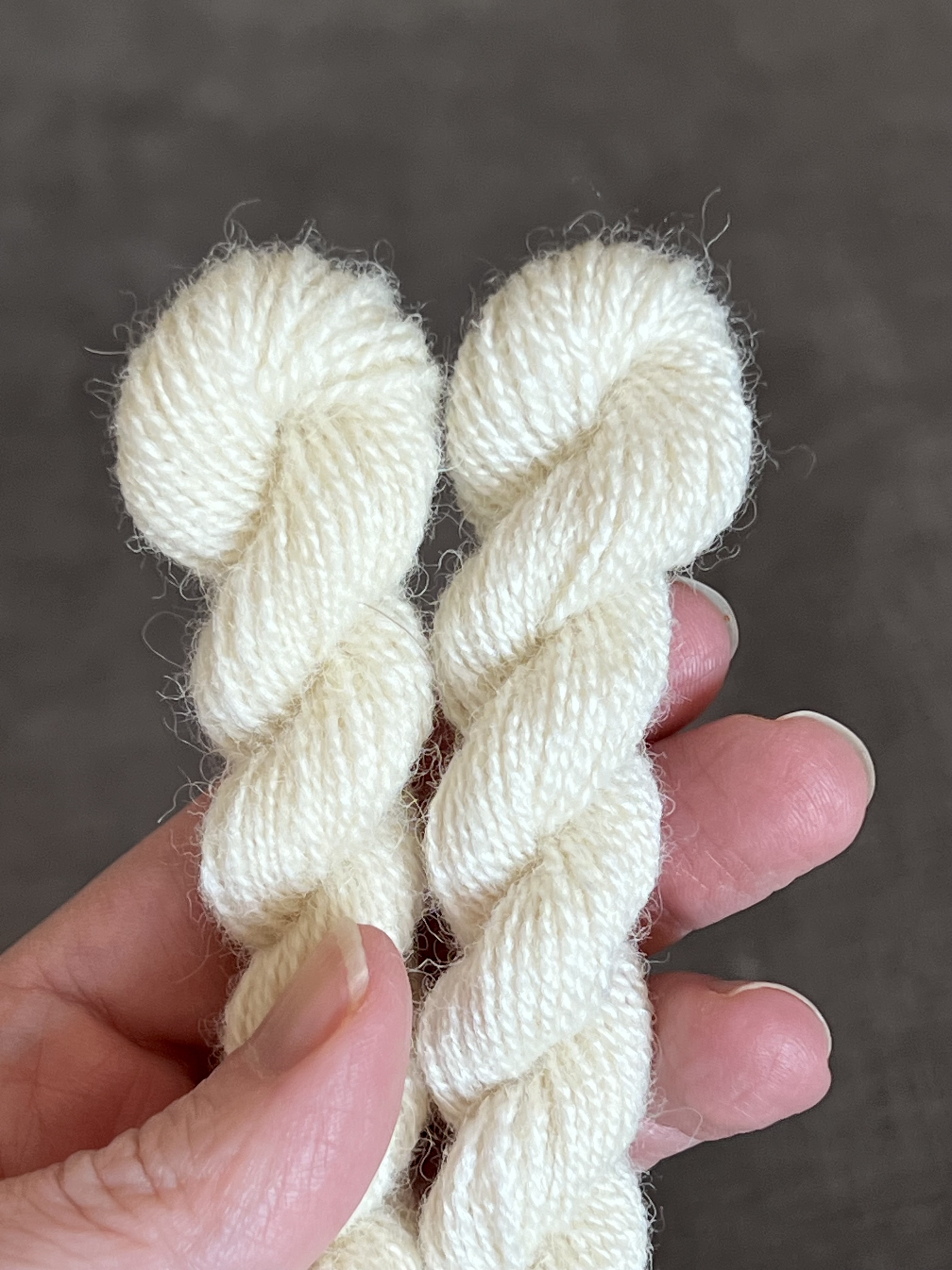
This is where I finally arrived at my perfect blending method. While it wasn’t flawless (there were still occasional spots of just Bombyx Silk or just Romney wool), overall, it was a great spinning experience. This blend spun almost exactly like the Corriedale, but without any neps, I never had to stop or slow down. This is due more to the prep than to the breed.
Back on the Spinning Luxury Fibre page, I explained why I chose Romney as my long wool instead of a more extreme long wool like Wensleydale or Lincoln. It was because I had recently purchased a raw Romney fleece, and despite just starting to process it, all the samples I have spun have an incredible sheen. While rummaging through my stash, I stumbled upon this commercial Romney, which seemed dull and lifeless in comparison. I was hoping that blending it with silk would bring it back to life.
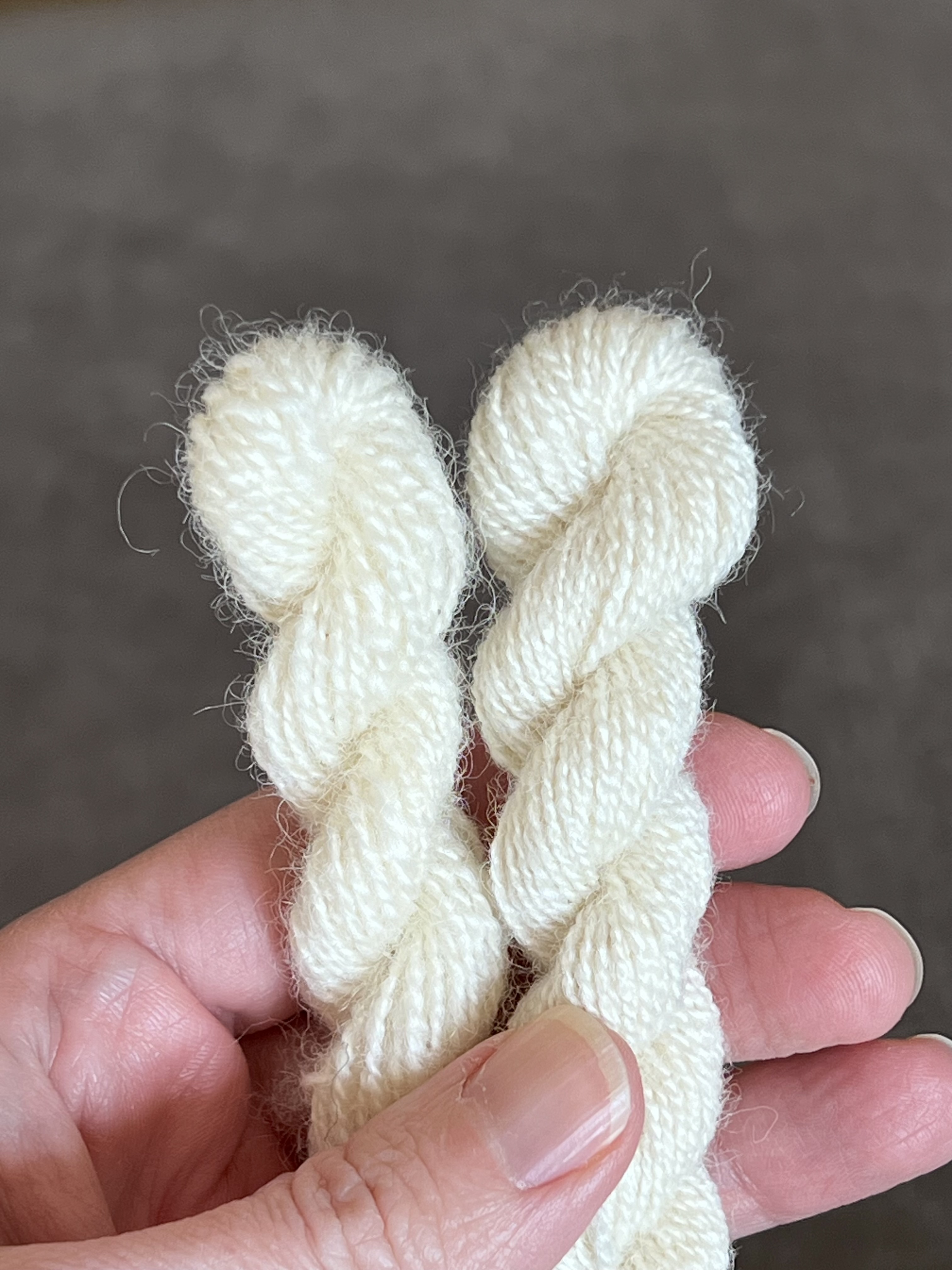
This picture perfectly illustrates my point. On the left is my woollen-prepared and woollen-spun Romney sample from my raw fleece. To the right is the worsted-prepared commercial Romney blend with silk. Even in a woollen state, my raw wool sample exhibits more lustre than the commercially processed wool blended with silk. Incredible eh?
Working from raw fleece may have more steps and it takes longer to reach the spinning stage, but it demonstrates how commercial wools undergo intense treatments during the scouring and combing process, resulting in a loss of some of their best qualities. One of the reasons many of us choose to spin our own yarns is having the control to create yarns perfectly suited for our projects and accentuating the best characteristics of the wool. Working from raw fleece means we can highlight these features even further. I find this topic so fascinating. But I will talk about raw fleece in a different post later on.
Shetland-Primitive Wool

I found my perfect blending style with Romney, but it’s with Shetland that I’ve truly honed it. Throughout the process, I never felt like I was spinning just silk or just Shetland; rather, they merged seamlessly into one unified fibre. It was a pure spinning bliss! I approached it almost identically to how I normally spin Shetland, and the outcome exceeded my expectations. It’s incredibly satisfying to see how my experimentation and fine-tuning have resulted in such a perfect yarn.
It’s interesting to note that both the Romney and Shetland spinning felt similar to spinning Corriedale in terms of drafting distance, drafting style, and the overall look and feel of the samples. Each of these breeds gained sheen and added softness because of the blend.
Cheviot-Down
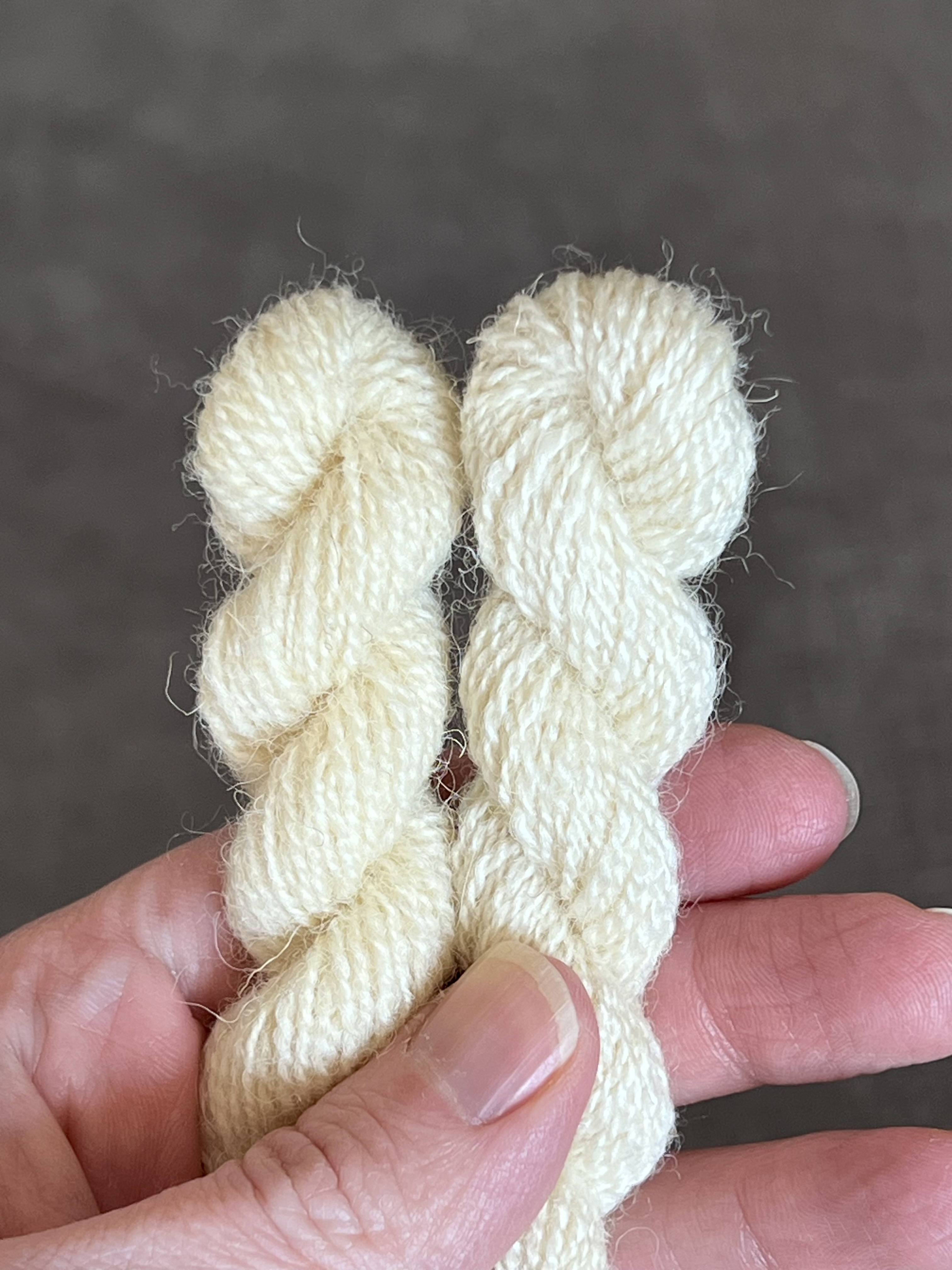
Spinning this blend felt somewhere in between the Polwarth and Corriedale spinning. My hand tightened up a bit like working with a fine wool yet the feel and staple length felt more like Corriedale. The fluffy and crimped nature of the Cheviot wool seemed determined to separate from the silk; as it seemed easy to spin the silk right out from the Cheviot wool no matter how well it was blended. Because of this, I had to remain focused to maintain consistent drafting of both fibres throughout the entire spinning process.
This wool/silk sample showcased the most significant difference in both appearance and texture when compared to any of the samples. Similar to my other blends, this wool will also benefit from the added sheen and softness of the silk. Cheviot, being naturally creamy in colour, brightens up significantly when blended with the cool white Bombyx silk.
Sampling thoughts for Bombyx Silk
It’s been challenging for me to draw definitive conclusions about the best Bombyx silk-wool blends, especially considering my initial struggles in achieving a homogeneous blend with the first few samples. Cheviot seems to have the most drastic differences when comparing the samples I have spun.
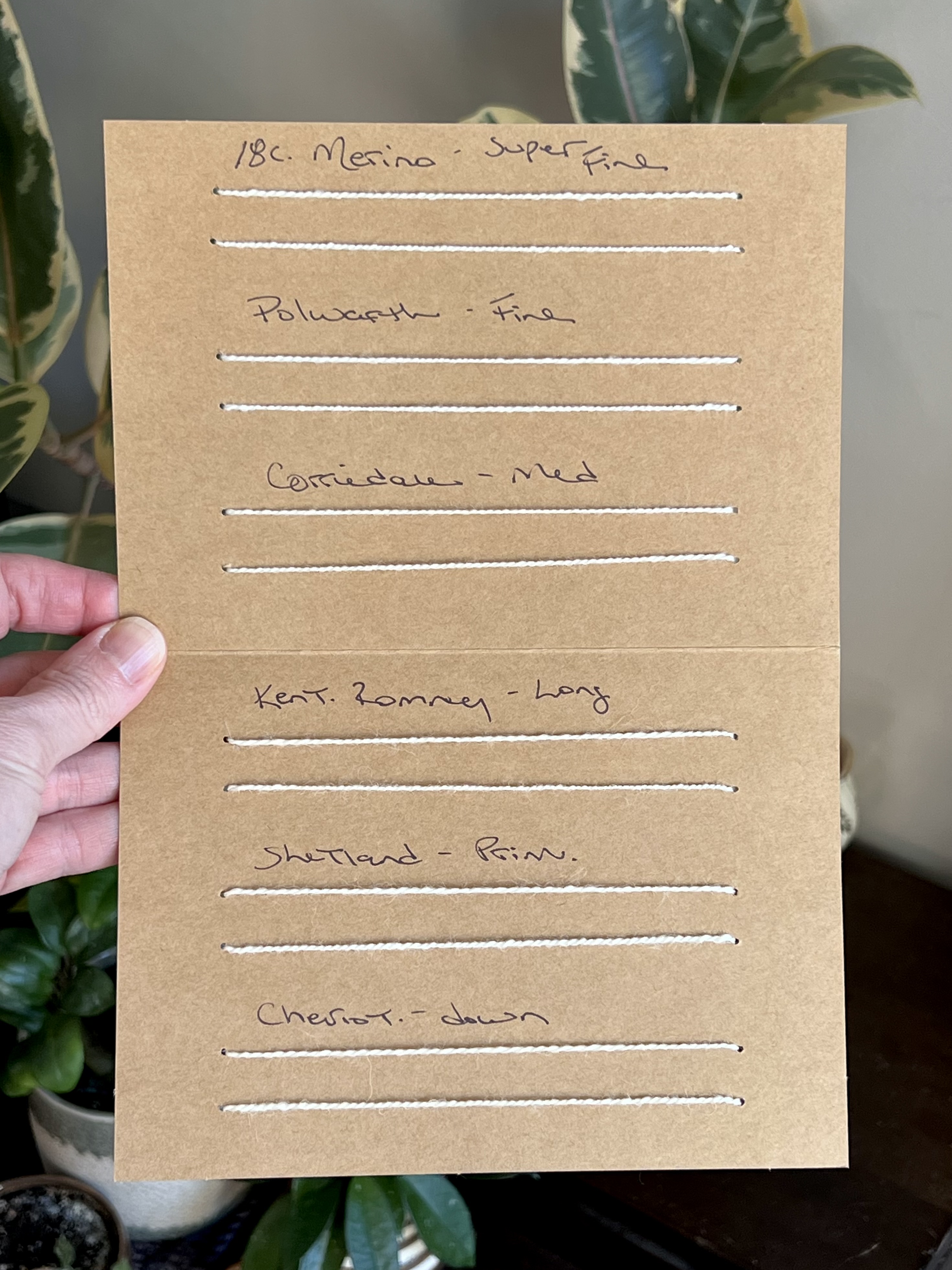
As explained on the Spinning Luxury Fibre, the top sample is before wet finishing and the bottom is after. While examining my plyback samples on the sample card, I noticed they didn’t fully represent the 5g samples as they should have; the plybacks were all taken directly from the wheel within a minute or so of spinning, then I would continue on with spinning the rest of the 5g sample. Moving forward, I’ve decided to take all my card samples from the 5g mini skeins. I believe the 5g samples represent a truer spinning result as I have more time to become comfortable with each blend. While taking plyback samples during spinning is a helpful way to stay on track, I believe it may provide a somewhat false view of the actual result of each silk and wool blend.
Despite these challenges, I’ve found this spinning process to be incredibly informative and enriching. I’ve gained valuable insights into the blending process, such as understanding how extreme differences in silk-to-wool crimp can impact blend cohesion and the difficulty of thoroughly blending fibres with drastic staple length variations. If time allows, I may revisit this Bombyx Sample spin as my fibre prep may have skewed the initial results. However, I also have a lot more spinning to do along the way, so we’ll see how it goes.
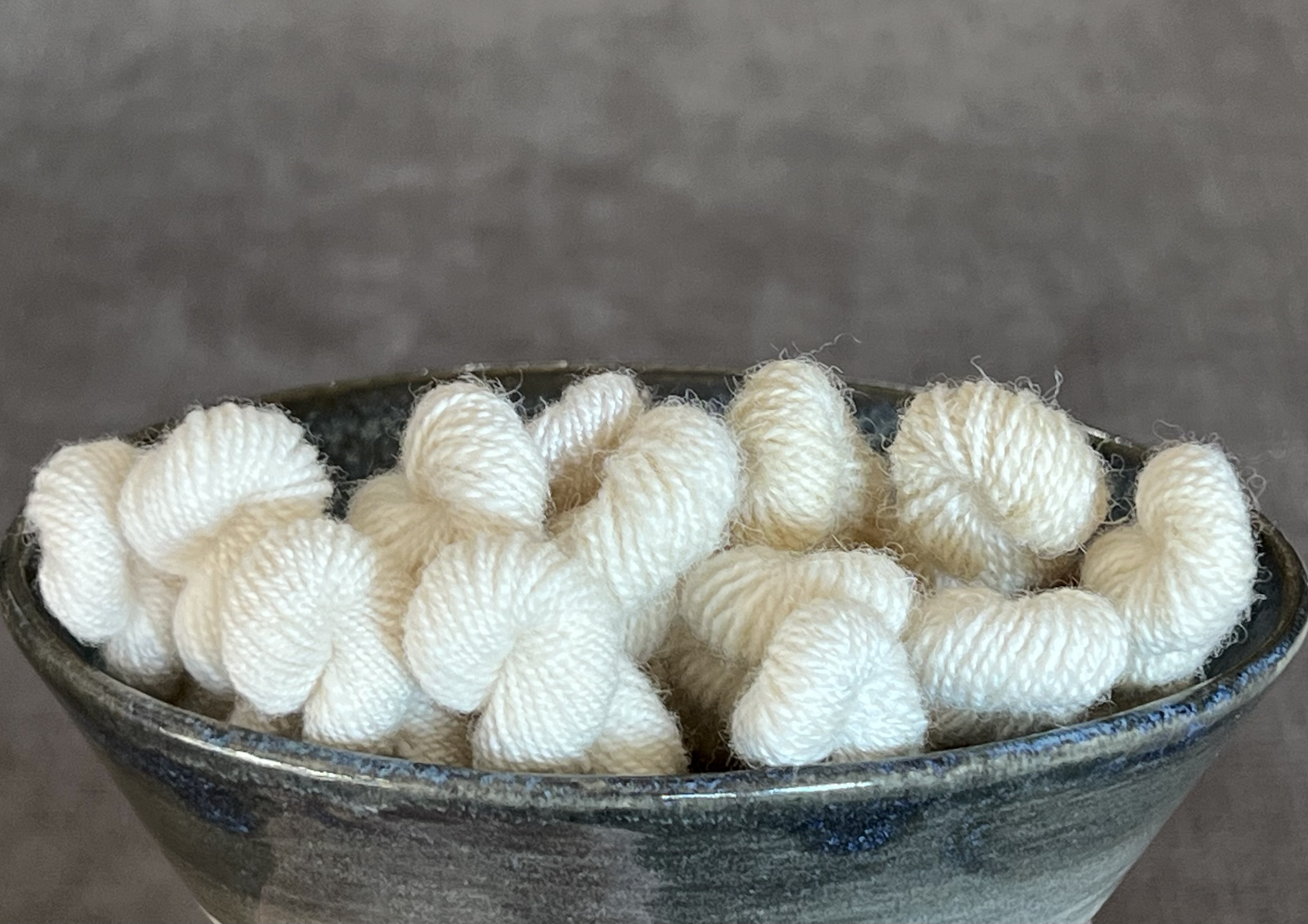
Spinning silk has brought me great joy once I relaxed, listened to the fibre, and took all the advice given along the way. Now, onto Tussah, the most common wild silk!
 Exploring Slowcrafts